Twelve years.
For twelve entire years, my daughter had not returned home once.
Yet every single year, without fail, she sent me exactly 8 million pesos.
Not a peso less.
Not a peso more.
People always told me how lucky I was.
“Your daughter married rich.”
“You’re living a comfortable life now.”
“You should be proud.”
But nobody understands the pain of receiving money while missing your child every day.
My name is Theresa.
I’m sixty-three years old, widowed, and Maria Luisa is my only daughter.
I raised her alone after her father died young.
She was intelligent, beautiful, and kind-hearted.
Everyone said she would have a wonderful future.
At twenty-one, she met a Korean man named Kang Jun.
He was wealthy, powerful, and almost twenty years older than her.
I objected immediately.
Not because he was Korean.
Because I was afraid of losing my daughter forever.
But Maria Luisa looked me straight in the eyes and said:
“Mom, I know what I’m doing.”
A month later, she married him and moved to Korea.
At the airport, she hugged me tightly and cried harder than I had ever seen before.
I cried too.
But I believed she would come home eventually.
She never did.
One year passed.
Then three.
Then seven.
Then twelve.
Every Christmas, the money arrived with the same short message:
“Mom, take care of yourself. I’m okay.”
But that word — okay — always frightened me.
During our video calls, she smiled politely, but her eyes looked exhausted.
Distant.
Like someone carrying a secret too heavy to speak aloud.
Whenever I asked why she never visited, she always answered quietly:
“I’m just busy with work, Mom.”
Eventually, I stopped asking.
Sometimes mothers become silent because they are terrified of hearing the truth.
The money changed my life.
I repaired the house.
Paid old debts.
Bought things I never imagined I could afford.
But every Christmas, I still cooked Maria Luisa’s favorite soup and set a plate for her at the table.
And every year, I ate alone.
Finally, after twelve years, I made a decision.
I was going to Korea.
I didn’t tell my daughter.
At sixty-three years old, I had never even been on a plane before.
The flight felt endless.
By the time I arrived, my hands were shaking from fear and exhaustion.
Korea felt enormous.
Bright lights.
Crowded streets.
A language I couldn’t understand.
I showed the taxi driver the address Maria Luisa once mailed to me years earlier.
Eventually, we stopped in front of a large two-story house in a quiet neighborhood.
It looked expensive.
Perfect.
But strangely cold.
I rang the bell.
No answer.
I noticed the gate wasn’t locked, so slowly, I walked inside.
The garden was neat, but silent.
No laughter.
No television sounds.
No sign of life.
My hands trembled as I opened the front door.
And the moment I stepped inside…
I froze.
The house looked spotless.
Too spotless.
Like a model home nobody actually lived in.
No shoes near the entrance.
No family photographs.
No smell of food or coffee.
No warmth.
I called softly:
“Maria?”
Silence answered me.
The flowers on the table were fake.
Cold plastic.
I walked into the kitchen.
The refrigerator was almost empty.
Only bottled water and old fruit remained inside.
Fear slowly tightened in my chest.
I walked upstairs.
Three doors waited at the end of the hallway.
The first bedroom contained only one bed.
One pillow.
One blanket.
The closet was filled entirely with women’s clothing.
There was no trace of a man.
No jackets.
No shoes.
Nothing.
The second room looked like an office.
Clean.
Organized.
But strangely unused.
Again, there was no sign of Kang Jun anywhere.
It was as if he had never existed.
My breathing became uneven as I reached for the final door.
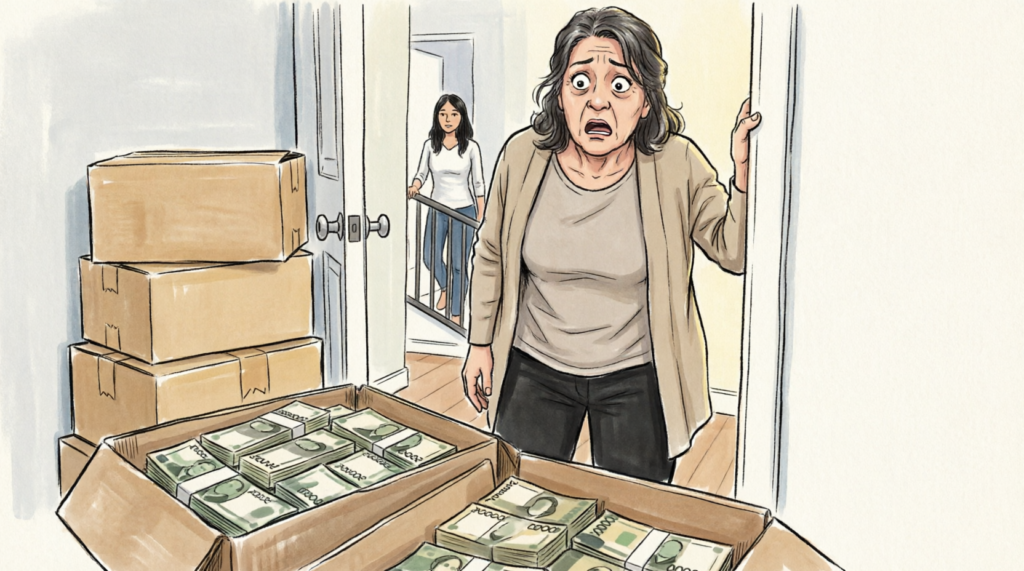
When I opened it, my knees nearly collapsed beneath me.
Boxes.
Stacks of them.
Some already open.
Inside were huge bundles of cash.
Millions of pesos.
My hands shook violently as I touched one of the stacks.
Why was all this money hidden here?
And where had it really come from?
Suddenly, I heard footsteps downstairs.
Slow.
Weak.
Then a familiar voice whispered softly:
“Mom…?”
I ran downstairs immediately.
Maria Luisa stood near the doorway.
We stared at each other silently.
After twelve years, she still looked beautiful.
But thinner.
Tired.
Like life had slowly drained something from her.
Then she hugged me tightly without saying a word.
I finally whispered:
“What is happening here?”
She pulled away slowly and looked down.
“Mom… I’m not really married.”
The world around me stopped.
“What do you mean?”
Tears filled her eyes.
“Kang Jun isn’t my husband.”
Every word felt like a knife through my chest.
Twelve years earlier, because of our debts, my medical bills, and our poverty, Maria Luisa accepted a contract in Korea.
She worked for wealthy men connected to Kang Jun’s company.
She attended events.
Pretended to be someone she wasn’t.
Smiled when she had to.
Stayed silent when ordered.
The beautiful life everyone envied was actually a cage.
The money came with strict rules.
If she left early, she would owe everything back.
More than ninety million pesos.
She still had two years remaining on the contract.
I felt sick listening to her.
My daughter wasn’t living.
She was surviving.
That night, while she prepared herself to attend another dinner for Kang Jun’s business associates, I watched her apply makeup in silence.
She looked perfect on the outside.
Completely exhausted inside.
After she left, I found a folder hidden upstairs.
Inside were contracts with terrifying conditions.
No relationships.
No freedom.
No public scandals.
Every detail of her life controlled.
For twelve years, my daughter had sacrificed herself just to protect me from poverty.
When Kang Jun arrived home later that night, he looked cold and emotionless.
Before leaving the room, he said only two words:
“Two years.”
As if my daughter’s entire life was just a business arrangement.
That night, Maria Luisa cried beside me for the first time in years.
“I’m tired, Mom,” she whispered.
I held her hands tightly.
“I don’t need the money anymore,” I told her. “I need my daughter.”
For a long time, she said nothing.
Then finally, quietly:
“I’m scared.”
The next morning, I made my decision.
I sold my house back home.
Used every savings account I had.
And together, we paid everything required to end the contract early.
The day Maria Luisa walked out of that office for the last time, she stopped outside beneath the sunlight and closed her eyes.
Then she whispered:
“It’s finally over.”
We returned home together.
No luxury.
No giant celebrations.
Just peace.
Months later, Maria Luisa opened a small restaurant near our neighborhood.
Nothing fancy.
Simple food.
Simple life.
But for the first time in twelve years…
Her smile looked real.
And every evening, when I watch her laughing with customers in that tiny restaurant, I realize something important:
Freedom may cost everything.
But sometimes…
It is the only thing truly worth paying for.