I still remember the morning I held that plane ticket in my trembling hands. My heart wouldn’t slow down no matter how many deep breaths I took.
Twelve years.
For twelve long years, my daughter Mary Lou had lived in Korea without coming home even once. Yet every single year, without fail, she sent me $100,000. Always on time. Always with the same short message:
“Mom, take care of yourself. I’m doing well.”
Everyone in town called me lucky.
“Your daughter married rich.”
“She takes such good care of you.”
“You must be proud.”
But no amount of money can replace hearing your child laugh across the dinner table.
My name is Theresa. I’m sixty-three years old, widowed young, and Mary Lou is my only child. I raised her alone, working double shifts so she could go to school and have the life I never had.
She was smart. Beautiful. Kind.
And at twenty-one, she fell in love with a Korean man named Kang Jun, nearly twenty years older than her.
I tried to stop her.
Not because he was Korean, but because she was so young and so determined to leave the country forever. But Mary Lou looked at me with tears in her eyes and said:
“Mom, I know what I’m doing.”
A month later, she was gone.
At the airport, she hugged me so tightly I could barely breathe. She cried harder than I did. I thought she’d come home after a year or two.
She never did.
The years passed quietly. The money kept arriving. My house became nicer. My life became easier.
But my heart became emptier.
Every Christmas, I still cooked her favorite stew and placed a second plate at the table out of habit. Sometimes I’d stare at the steam rising from the food and wonder if my daughter was truly happy… or simply surviving.
Then one winter morning, I finally made a decision.
I was going to Korea.
I told nobody.
For a woman my age who had never even left the country before, the trip felt terrifying. My neighbor helped me book the flight and prepare the documents. During the flight, I gripped the armrest so tightly my fingers turned pale.
When I finally arrived in Seoul, everything felt unfamiliar. Strange language. Strange streets. Strange faces.
I gave the taxi driver the address Mary Lou had sent years earlier.
The house was beautiful.
Large. Quiet. Perfect.
Too perfect.
I rang the bell.
No answer.
The front gate wasn’t locked, so slowly, nervously, I stepped inside.
The garden was neat but lifeless. No music. No television. No sound of people living there.
My chest tightened as I reached for the front door.
When it opened… I froze.
The house looked like a furniture showroom.
Everything spotless.
Everything arranged.
But nothing felt lived in.
No family photos.
No scattered shoes.
No smell of food.
No sign of a husband.
“Mary?” I called softly.
Silence.
I walked through the kitchen. The refrigerator was nearly empty except for water bottles and old fruit. Upstairs, I found three rooms.
The first bedroom had only one pillow.
One blanket.
One life.
The closet held only women’s clothes.
No men’s jackets. No ties. No trace of Kang Jun.
The second room looked like an office nobody used anymore.
And the third room…
The moment I opened it, my knees nearly gave out.
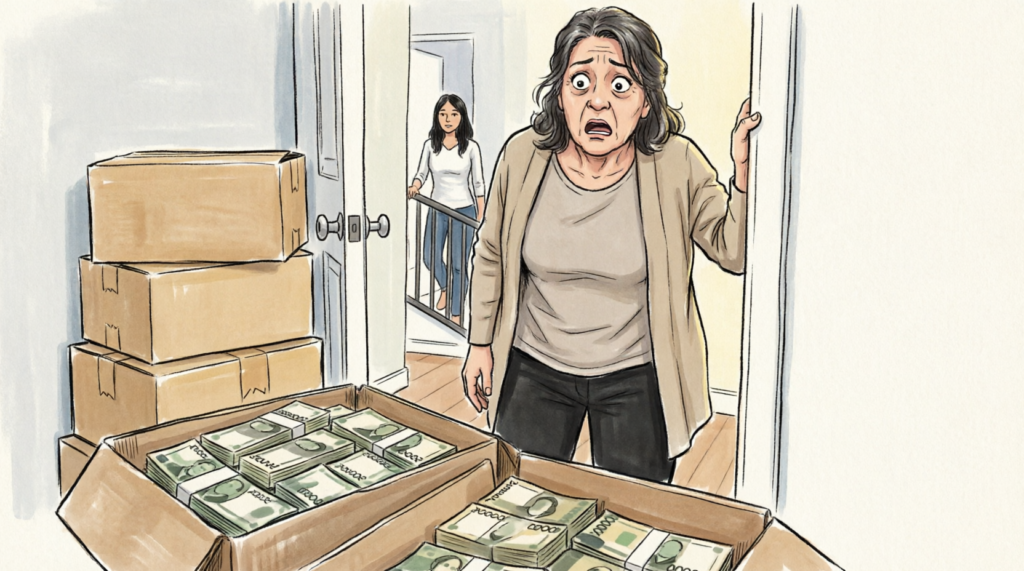
Stacks of cash.
Boxes filled with bundled American dollars.
Thousands.
Maybe millions.
My hands shook as I touched one stack.
If she already sent me $100,000 every year… then where had all this money come from?
And why was it hidden?
Suddenly, I heard the front door downstairs open.
Soft footsteps echoed through the silent house.
Then I heard a voice.
“Mom?”
I turned so fast I almost fell.
Mary Lou stood at the bottom of the stairs.
Older. Thinner. Beautiful… but exhausted.
For a moment neither of us moved.
Then she walked toward me and hugged me tightly.
No tears.
Just silence.
The kind of silence people carry after surviving too much for too long.
I held her face in my hands.
“What is this place?” I whispered. “Where’s your husband?”
Her eyes dropped to the floor.
Then she quietly said the words that shattered everything I believed for twelve years.
“Mom… I was never married.”
The room spun around me.
“What?”
She swallowed hard.
“Kang Jun paid me to stay with him. To appear beside him. To live the life he wanted people to see.”
Every word felt like a knife.
She explained everything slowly.
Years earlier, when I got sick and debt buried us, she accepted an arrangement in Korea. Kang Jun was wealthy and powerful. He needed someone beautiful, educated, and obedient at his side.
In exchange, he gave her money.
A house.
Security.
But not freedom.
“I had contracts,” she whispered. “Rules. Conditions. I couldn’t leave early unless I paid everything back.”
I stared at my daughter and realized she hadn’t been living a dream.
She’d been trapped inside one.
That night, I cooked soup while she sat quietly at the kitchen table. She ate slowly, like someone remembering what comfort felt like.
Before leaving again, she accidentally left behind a small silver key.
I used it to open a locked cabinet upstairs.
Inside was a thick folder.
Contracts.
Legal agreements.
Penalties.
Control.
If she left before the agreement ended, she would owe more money than either of us could imagine.
My daughter had spent twelve years living inside a golden cage.
Later that evening, Kang Jun himself arrived.
Tall. Calm. Cold.
He looked at me like I was an unexpected problem.
“Two more years,” he said before leaving.
That night, Mary Lou and I slept side by side like we used to when she was little.
“Are you happy?” I finally asked her.
She stared at the ceiling for a long time before answering.
“No, Mom. I’m just tired.”
I took her hand tightly.
“I don’t care about the money anymore. I just want my daughter back.”
For the first time in years, she cried.
The next morning, I made my decision.
I sold my small house back home and used everything I had to help buy her freedom.
The pressure from Kang Jun became worse after that. Calls. Threats. Deadlines.
But Mary Lou no longer looked afraid.
Months later, we walked together into his office one final time.
Mary Lou wore no makeup.
No expensive dress.
No fake smile.
Just herself.
Kang Jun signed the papers silently.
Then he looked at her and said:
“It’s over.”
Outside the building, sunlight covered the city streets.
Mary Lou stopped walking, closed her eyes, and breathed deeply.
Then she smiled through tears.
“I’m finally free.”
We returned home quietly.
No celebration.
No dramatic reunion.
Just a mother and daughter carrying two suitcases through the airport together.
A few months later, Mary Lou opened a small restaurant near the market.
Nothing fancy.
Just homemade food and honest work.
The first customer was a tricycle driver who smiled after one bite and said:
“This tastes like home.”
I watched my daughter’s face light up brighter than it ever had inside that mansion in Korea.
And in that moment, I realized something important:
Freedom may cost everything.
But living without it costs even more.
Moral:
Sometimes the life that looks perfect from the outside is hiding loneliness, sacrifice, and pain. Real happiness is not found in wealth or appearances — it’s found in freedom, peace, and being able to live as your true self.